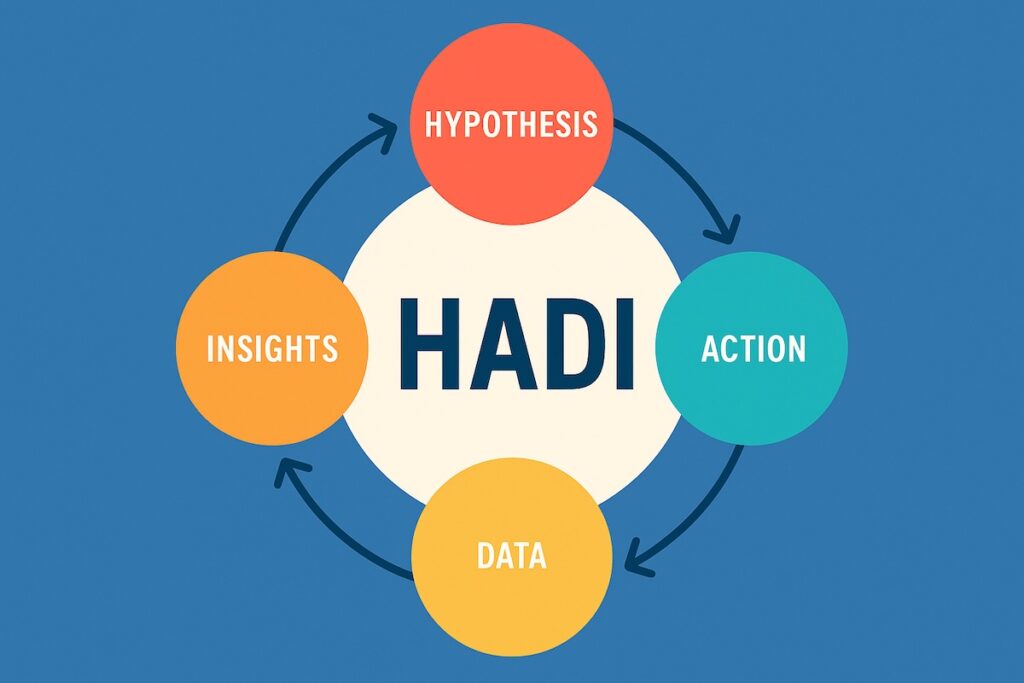
The HADI cycle is a simple but powerful way to validate ideas, reduce risk, and drive improvement. When paired with the PDCA approach, it becomes a repeatable method to test smart, act fast, and learn continuously.
The Four Pillars of HADI
1. Hypothesis
Formulate a clear “if… then…” statement that is specific, measurable, achievable, relevant, and time-bound (SMART).
Example:
- Less effective: Start online sales.
- Stronger: If we launch a sushi delivery app for Moscow and St. Petersburg, we will double revenue by Q2 next year.
2. Action
List the concrete steps you will take. This could include launching an app, testing its user experience, creating landing pages, or collecting customer feedback.
Use prioritization tools like uncertainty-cost matrices to decide what to test first—especially for complex or expensive initiatives.
3. Data
Define the metrics you will track before taking action. Consider the sources, processing methods, and analysis approach.
Remember that human interpretation is essential—numbers alone can mislead if the sample is unrepresentative or the context is ignored.
Qualitative feedback, such as user comments, can be just as valuable as quantitative data.
4. Insights
At the end of the cycle, analyze the results and decide next steps.
Possible outcomes:
- The test was poorly designed – redesign and try again.
- The hypothesis was disproven – document and move on.
- The hypothesis was confirmed – choose one of three paths:
- Scale it, but monitor results closely.
- Continue testing if monetization is still unclear.
- Pivot if the problem is clear but the solution is not.
Why This Matters
- Avoids costly, large-scale changes by testing in small increments.
- Encourages speed and flexibility—each cycle builds on the last.
- Creates team alignment and shared learning from every test.
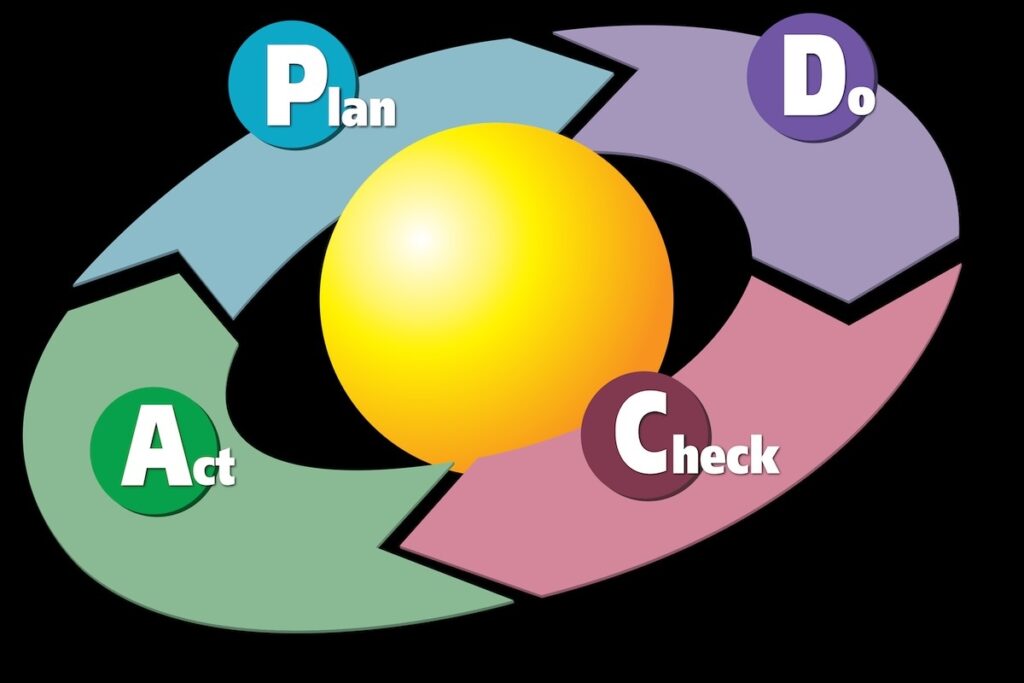
Adding the PDCA Layer
HADI aligns naturally with the PDCA cycle:
- Plan: Formulate your hypothesis and action plan.
- Do: Execute the planned steps.
- Check: Measure results with data.
- Act: Apply insights—whether that means scaling, adjusting, or pivoting.
When HADI is embedded into a PDCA loop, it creates a sustainable rhythm of continuous learning and improvement. This approach helps teams innovate while managing risk, ensuring progress is based on evidence—not assumptions.